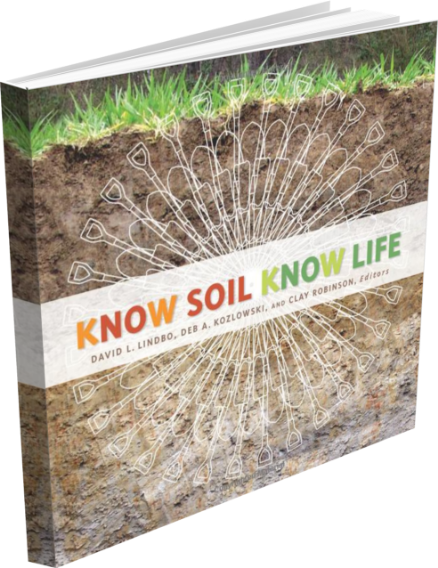
Know Soil, Know Life Glossary
This glossary is designed for more advanced explorations of soil science terms and words. The words and definitions are from the SSSA Book Know Soil Know Life.
Not finding a word? Try the advanced Glossary of Soil Science Terms. Too advanced? Check out the Young Scientists glossary for introductory words and definitions.
| Term | Description |
|---|---|
| Hydraulic Conductivity |
Amount of water (liquid) that can move through a unit area of soil in a unit of time (see permeability). |
| Hydrophobic Soils (Hydrophobicity) |
The tendency for a soil particle or soil mass to resist hydration, usually quantified using the water drop penetration time test. |
| Hydrophyte |
Plants that are adapted to grow in water or wetlands. |
| Hydrosphere |
All the waters on the earth’s surface, such as lakes and seas, and sometimes including water over the earth’s surface, such as clouds (the water). |
| Hyperthermic |
average annual soil temperature is high than thermic, sometimes referred to as the citrus belt |
| Hypha (Plural: Hyphae) |
Long filaments or threads that are part of the structure of fungi and actinomycetes. |
| Illuviation |
The translocation (deposition) of soil material in a soil horizon that has been removed from another horizon by eluviation; usually from an upper to a lower horizon in the soil profile. |
| Immobilization |
Conversion of plant available nutrients to an organic form which is unavailable to plants. |
| Inceptisols |
Weakly developed soils—almost anywhere. |
| Infiltration |
The entry of water into soil. |
| Integrated Pest Management (IPM) |
A system that uses a combination of biological, cultural, mechanical, chemical, and regulatory tools to control pests such as weeds and insects. |
| Ion Exchange |
The interchange between an ion in solution and another ion in the boundary layer between the solution and surface of a charged material such as clay or organic matter. |
| Internal drainage |
Related to how water moves through the soil due texture, structure and consistence. |
| Irrigation |
The intentional application of water to the soil, usually for the purpose of crop production. |
| Isomorphic Substitution |
The replacement of one element for another in a mineral structure or crystal without disrupting the mineral. |