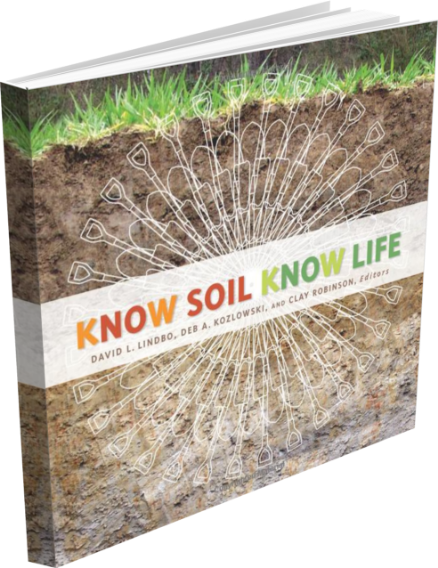
Know Soil, Know Life Glossary
This glossary is designed for more advanced explorations of soil science terms and words. The words and definitions are from the SSSA Book Know Soil Know Life.
Not finding a word? Try the advanced Glossary of Soil Science Terms. Too advanced? Check out the Young Scientists glossary for introductory words and definitions.
| Term | Description |
|---|---|
| Sodification |
The process whereby the amount of exchangeable sodium in a soil is increased. |
| Soil |
A natural, three-dimensional body at the earth’s surface. It is capable of supporting plants and has properties resulting from the effects of climate and living matter acting on earthy parent material, as conditioned by relief and by the passage of time. |
| Soil Quality |
Generalized term used to describe a soil’s ability to properly function and sustain plant, animal, and microbial productivity and maintain or enhance air and water quality. |
| Soil Map |
A map showing the distribution of soils or other soil map units in relation to the prominent physical and cultural features of the earth’s surface. Five soil maps are recognized in the United States: detailed soil map, detailed reconnaissance soil map, generalized soil map, reconnaissance soil map, and schematic soil map. |
| Soil Moisture Regimes |
Refers to the moisture content in the upper portion of the soil, they include Aquic, Aridic, Udic, Ustic, and Xeric types |
| Soil Order |
A group of soils in the broadest category. For example, in the 1938 classification system. The three soil orders were zonal soil, intrazonal soil, and azonal soil. In the 1975 there were 10 orders, whereas in the current USDA classification scheme there are 12 orders, differentiated by specific characteristics or properties: Alfisols, Andisols, Aridisols, Entisols, Gelisols, Histosols, Inceptisols, Mollisols, Oxisols, Spodosols, Ultisols, Vertisols. Orders are divided into suborders and the suborders are further divided into great groups. |
| Soil Organic Matter |
Component of soil that contains carbon and is living or once was living but now is in various states of decomposition. |
| Soil Series |
The lowest category of u.s. system of soil taxonomy. A soil series is named for the area in which it was first mapped. A soil series is based on specific morphological, physical and chemical properties that make it unique. It is equivalent to the species level in Linnaean classification. |
| Soil Survey |
(i) the systematic examination, description, classification, and mapping of soils in an area; (ii) the program of the national cooperative soil survey that includes describing, classifying, mapping, writing, and publishing information about soils of a specific area. |
| Soil Taxonomy |
U.S. Department of Agriculture–Natural Resource Conservation Service basic system of soil classification for making and interpreting soil surveys. |
| Soil Temperature Regimes |
Refers to the average annual soil temperature at 50 centimeters (20 inches) below the soil surface. There are six different regimes: Gelic, Cryic, Frigid, Mesic, Thermic, Hyperthermic. |
| Spodosols |
Acidic, sandy forest soils under conifers—sandy areas of the northeast to Minnesota, sandy areas of the Atlantic coastal plain. |
| Springtail |
Six-legged mesofauna or macrofauna that feed on organic materials or other smaller organisms. Most in soil are too small to be seen with the unaided eye. |
| Strip Cropping |
The practice of growing two or more crops in alternating strips along contours, often perpendicular to the prevailing direction of wind or surface water flow. |
| Structure |
The combination or arrangement of primary soil particles into secondary units or peds. The secondary units are characterized on the basis of size, shape, and grade (degree of distinctness). |