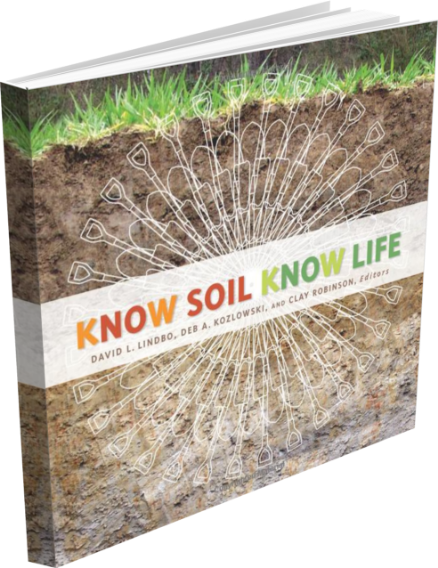
Know Soil, Know Life Glossary
This glossary is designed for more advanced explorations of soil science terms and words. The words and definitions are from the SSSA Book Know Soil Know Life.
Not finding a word? Try the advanced Glossary of Soil Science Terms. Too advanced? Check out the Young Scientists glossary for introductory words and definitions.
| Term | Description |
|---|---|
| Anion exchange capacity (AEC) |
Quantity of positive charges on surfaces of mineral and organic matter that attracts anions. |
| Angiosperm |
Flowering plant in which the mature seed is surrounded by the ovule (such as an apple, oak, daisy, grasses). |
| Antibiotic |
Organic compound that in low concentrations is inhibitory to other organisms. |
| Arable |
Land that is capable of sustaining crops, where production is practical and economically feasible. |
| Arbuscule |
Highly branched structure formed by endomycorrhizal fungi within root cortical cells. |
| Archaea |
Prokaryotic single-celled microorganisms some of which live in extreme environments. |
| Aridisols |
Desert soils—desert areas worldwide. |
| Arthopod |
An invertebrate animal having an exoskeleton, a segmented body, and jointed appendages including insects, arachnids, and crustaceans. |
| Assimilation |
Uptake or utilization of an element by an organism. |
| Association |
A map unit composed of two or more soil series occurring together in a characteristic, repeating pattern. |
| Atmosphere |
The envelope of gases surrounding the earth (the air). |
| Bacterium (Plural: Bacteria) |
Prokaryotic single-celled microorganism common in soil that lacks a nucleus or other membrane-bound internal structures. |
| Base Saturation |
Proportion of the cation exchange capacity occupied with basic cations (Ca+2, Mg+2, K+). |
| Berlese Funnel |
Method of extracting small animals from soil by use of a heat/light source. |
| Best Management Practice (BMP) |
Any of a group of practices that conserve soil and water resources. |